Stay Informed: Updates, Events and Stories
A Little Dot Above the “I”: A Life in Libraries and Interlibrary Loan

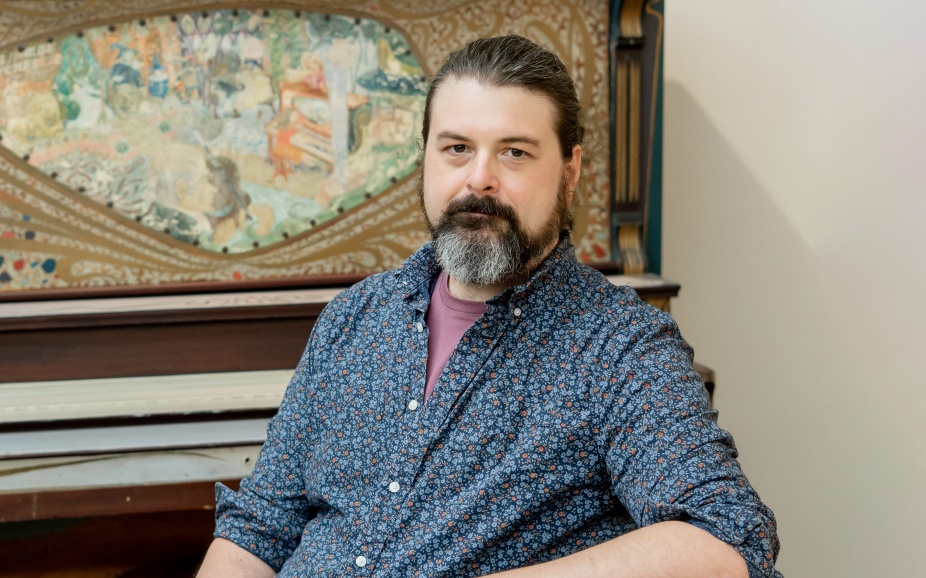
by DENISE WOLFE
Published January 13, 2026
Some careers choose us as much as we choose them. For Joshua Gordon, resource-sharing assistant in Delivery Services, what began as a college job to pay for "gas and shoes" evolved into a calling. His journey from the periodicals window at St. Bonaventure to seven years facilitating interlibrary loans at UB is a story of finding home among books, quiet spaces and the belief that all knowledge really does belong to all people.
How did you end up working in libraries?
When I was 17, I decided I was going to be a world-famous writer. Of course! So I went to school for English and philosophy. Naturally! The trick was putting gas in the car and shoes on my feet in the meantime, which, for a boy of my means, meant a job.
When I arrived at St. Bonaventure University as a freshman, I'd heard the easiest gig on campus was working the periodicals window at Friedsam Library. It was quiet. They gave you a stool to sit on. They let you do homework during your shift. So I (politely!) annoyed the assistant to the director until they hired me.
I had no interest beyond the paycheck and the study time. That is, until my supervisor, Dennis O'Brien, a man to whom I am eternally grateful, pointed out that some people do, in fact, become librarians—on purpose! And wouldn't you know, UB had a library school, just up the road. Gas and shoes forever.
What made you fall in love with library work?
I transferred schools after that first year but kept coming back to Friedsam to work over the summers. I loved it there—I loved the stacks chock full of things I could never hope to read all of in a lifetime; I loved the weird little projects I got asked to do; I loved the way the big window on the top floor opened up to what felt like the whole world. And something about the way the floating stone stairs carried the quiet tap-tip-tap of my ratty pink Chucks made me want to do it forever.
Tell us about your path to UB.
Eventually, I got accepted into UB. I came for the MLIS, which I finished in 2010; I stayed because, after all, I'd found home.
I started as a graduate assistant in the Poetry Collection, then a cataloger. I got to work with the Joyce collection, which is heaven for a pretentious wannabe writer, sure, but also all sorts of obscure and bizarre chapbooks and mail art and zines and cool things like letters and manuscripts from Robert Graves and Dylan Thomas and William Carlos Williams.
As a student, I got to take classes with Dr. Valerie Nesset and Dr. Brenda Battleson—who stand tall in my personal pantheon of good and righteous people—and who taught me all I needed to know: That all knowledge belongs to all people.
What happened after you graduated?
A few twists and turns, including a stretch writing and editing curricula for New York State child welfare training, and two kids (Lev, 12, and Yael, 9). I landed back at UB as a visiting assistant librarian tasked with cleaning up digital scans for ingest into HathiTrust. When a spot opened in Delivery for a resource-sharing assistant, I jumped at the chance.
Last November marked seven years, much of which I've spent negotiating with ILLiad and the U.S. Postal Service to bring all of the knowledge to all of the people. There's no place I'd rather be.
What do you enjoy most about your work?
I get to do work every day that aligns with my values, and I get to do it alongside kind, conscientious and absurdly smart colleagues. I'm just a little dot above one "i" in "interlibrary loan," and I'm grateful to be here. I really do get to connect people to information that, in my estimation, belongs to all of us, by rights.
Any key achievements you’d like to share?
My proudest and most humbling achievement is learning how to parent my kids in ways that support their becoming compassionate, conscientious human beings. Professionally, I once earned the very unofficial title of “Hardest working man” at a New York City newspaper after a 24-hour shift. I will happily never do that again.
I'm excited about implementing Rapido this spring—anything that reduces turnaround time and increases request accuracy is exciting in my book. I'm also thrilled to facilitate open student crafting sessions with the Student Library Engagement Workgroup, focusing on rubber-stamp carving. Making things also belongs to all people, and making things in community is the best way to do it.
Where did you grow up?
I grew up in Black Creek, near Cuba, New York—more a collection of hills and trees and a few houses and barns, with more cows and coyotes than people. Not much for a kid with an itchy brain. Which maybe explains why a slow reader whose mother would beg and bribe him to open a book would end up working in a library: Two things there are plenty of in a place like that are time and space.
What do you do outside of work?
I'm always a dad, working or not. But outside of work, I like to ride my bike—it's like a two-wheeled elsewhere machine that always brings me back. I also like to walk, collect weird paper, draw eyeballs and carve rubber erasers into stamps.
Now I pretend to be a librarian. And here I am: Home.