Stay Informed: Updates, Events and Stories
Archive Encounter: How UB's History of Medicine Collection Sparked New Creative Work

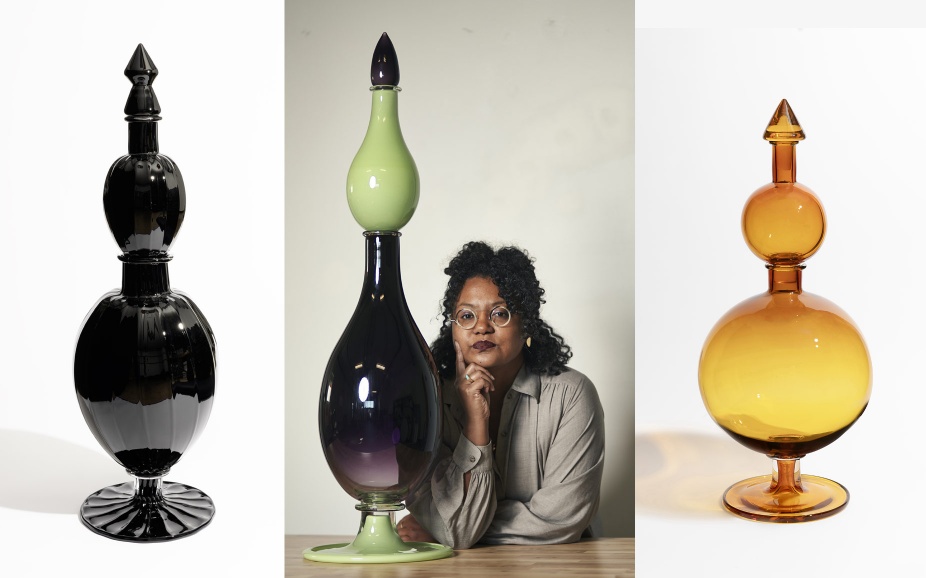
Left to right: Black Star Line (2024), blown glass created with the Museum of Glass; Crystal Z Campbell pictured with one of her blown glass works; and The Comet (after W.E.B. Du Bois) (2024). Glass works photographed by Ian Lewis; headshot by Brandon Watson.
by DENISE WOLFE
Published February 17, 2026
When Crystal Z Campbell walked into the University Libraries’ History of Medicine Collection, they weren’t expecting to begin a new body of artwork. Campbell, an associate professor in UB’s Department of Art and Media Study, had been preparing to teach a course exploring archival practice and material history. Instead, the experience reshaped their own work.
Campbell first encountered the collection while developing Artists and Filmmakers in the Archive, a course that emerged from their 2023–24 Freund Fellowship at Washington University in St. Louis. The fellowship allowed Campbell to design the kind of deep archival exploration they believe is often missing from studio education.
“There is something about accessing a primary source that can ignite or spark ideas through handling,” they said. “Sometimes it’s an olfactory sensation that triggers memory in a different way or trying to examine a document that is crumbling away.”
The collection itself is rich with possibility. The History of Medicine Collection includes more than 20,000 rare books, journals, anatomical models, instruments and other medical tools spanning centuries of health care. For Campbell, the visit offered a chance to consider not only what has been preserved in medical history, but also what has been overlooked.
“My approach to the archive, as an artist and educator, is to respond to both what has been preserved and consider what has been omitted and why,” they said.
Among the objects Campbell and their students examined, one set in particular captured Campbell’s imagination: 19th-century apothecary show globes — large blown-glass vessels once displayed in apothecary windows to signal to nonliterate customers that medical services were available. These eye-catching globes functioned symbolically, guiding the public through color and visual cues.
“I was mesmerized by them,” Campbell said. “There is a gravity to that scale of blown glass, combined with the expectation I had of what would be in a medical archive, and the intention of these show globes that caught my attention.”

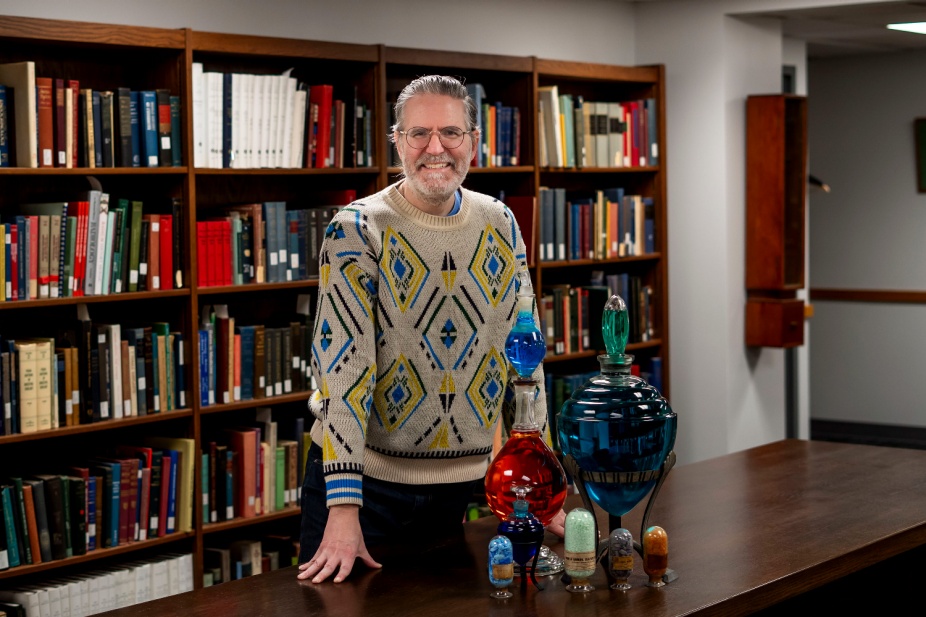
Keith Mages, curator of UB’s History of Medicine Collection, stands with 19th-century apothecary show globes, blown-glass vessels that once signaled medical services and later inspired new artistic work through the collection.
Just before this discovery, Campbell had been invited to the Museum of Glass for a residency in the Hot Shop. The timing made the influence of the historical vessels immediate. They began designing their own versions, working with glassblowers led by artist Ben Cobb. The resulting works echo the elegance and presence of their predecessors while placing them in new conceptual contexts.
Campbell’s interest in medical materials was not entirely new. Fifteen years earlier, they collaborated with a molecular geneticist in the Netherlands to create glass works exploring the legacy of Henrietta Lacks and the use of HeLa cells in biomedical research. But the show globes reconnected them with a different aspect of that inquiry: how bodies, medical science and visual culture intertwine.
After their initial visit, Campbell brought undergraduate and graduate students to the collection to examine artifacts firsthand. They hoped the experience would stretch their understanding of what research can be — and how artists can reimagine and reframe these histories.
“It is essential for collections like ours to cultivate connections with a wide range of patrons. Artists, such as Crystal, appreciate and interpret our holdings in surprising and unique ways, developing important new lenses through which we can view our historic medical artifacts. With this change in perspective comes an opportunity for human connection and intellectual growth, both hallmarks of place-based academic institutions such as University at Buffalo,” said Keith Mages, curator of UB’s History of Medicine Collection.
Students examined anatomical diagrams, medical illustrations and early instructional materials — a visual evolution that tells a cultural story about how medical knowledge has been recorded and revised over time.
“There’s a longstanding history between art and medicine and perception,” Campbell said. “These objects and images are reflective of ideologies, and there’s evidence of scientific ideologies shifting when looking closely at these materials.”
Campbell sees archival engagement not only as a research tool, but as a way of developing artistic empathy — grappling with the layers of history embedded in objects and the institutional systems that shape them.
“I’m careful not to romanticize the performance of the archive,” they said. “Archives often reflect systemic erasure, reinscribe power through gatekeeping and access, and limit whose stories are told.”
Their resulting pieces appeared in their solo exhibition at the St. Louis Art Museum, where the glass vessels acted as historical echoes — both honoring and challenging the narratives contained in the medical artifacts that inspired them.
This work was supported by a SPARC grant from UB’s College of Arts and Sciences, which funds innovative research, scholarship and creative practice.
Campbell expects their relationship with the History of Medicine Collection will continue to grow, and they see opportunities for expanded collaboration across departments and disciplines.
“I’m excited to connect with more medical practitioners, scientists and scholars and continue to activate the UB collections in my courses,” they said. “It’s critical to introduce art students to these possibilities between art and archives, and art and medicine.”