Stay Informed: Updates, Events and Stories
Preserving Parkside: University Archives Bring Neighborhood History Online

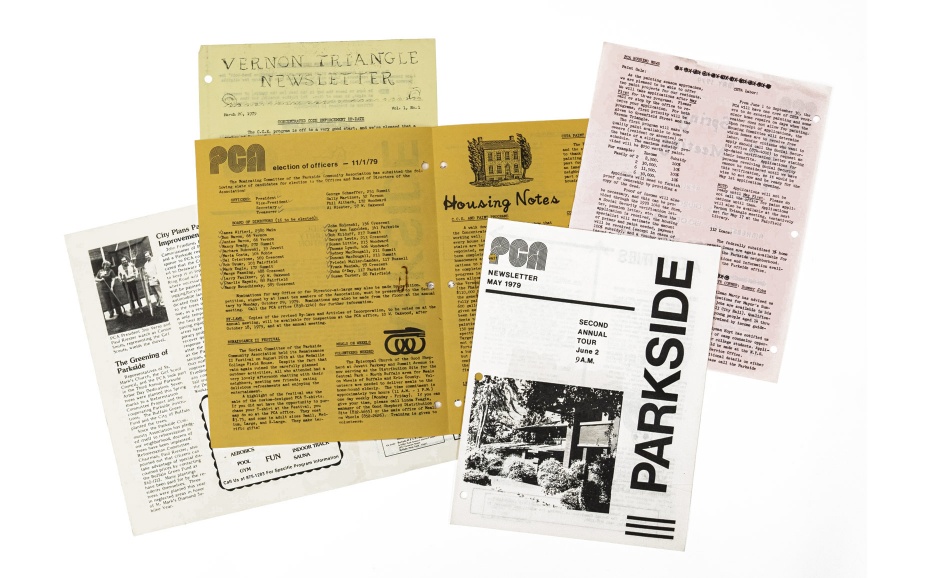
Recently digitized archival editions of the Parkside Community Association newsletter from 1979.
by DENISE WOLFE
Published March 3, 2026


A trove of historic documents chronicling more than four decades of Buffalo's Parkside neighborhood is now available to the public through a digitization project that exemplifies the power of community-university partnerships.
The University Archives has digitized 187 issues of Parkside News, spanning 1979 to 2023, from the Parkside Community Association (PCA) collection. The materials are now hosted openly through NYS Historic Newspapers, providing historians, researchers and community members with unprecedented access to the neighborhood's story.
“Digitizing Parkside News expands access to an important community record and highlights how collaborative efforts can safeguard local history and make it available to a much broader audience,” said Hope Dunbar, university archivist.

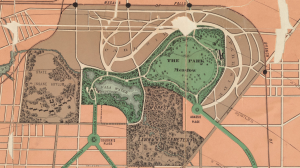
Frederick Law Olmsted's sketch map of Buffalo showing the park system, circa 1881. Original image cropped to feature the Parkside neighborhood.
The PCA donated the archival collection to the university, ensuring the materials would be preserved and accessible for future generations. The organization, Buffalo's largest membership-based community association, was founded in 1963 to combat redlining and blockbusting practices that threatened neighborhood stability.
The historic Parkside neighborhood flanks Delaware Park, designed by renowned landscape architect Frederick Law Olmsted, who also created the design blueprint for the Parkside area.
"Beginning in 1979, the Parkside News tracks the history of Buffalo through one neighborhood," said Braden Pritchard, PCA president and UB alumnus who earned his undergraduate degree in 2022 and law degree in 2025. "All the trials faced by a Rust Belt city of the era are on display: disinvestment by the city government, decaying buildings, urban freeways, and desegregation. The very first issue deals with the community's strategy for neighborhood revitalization."
The collection documents the neighborhood's evolution through challenging decades into a period of renewal.
“By the more hopeful days of the ’90s, we see a Parkside focused on new trends in community policing, reaching for any strategy to revitalize Main Street, including credit unions and co-ops, and pursuing historic restoration to long-neglected landmarks like the Martin House,” Pritchard said.
The digitization project served dual purposes: preserving community history while providing hands-on training for a library and information science graduate student who gained practical experience in archival work by scanning documents and creating metadata for the online collection.
"I learned so much about archival work that you can't get from a textbook. And honestly, reading through these newsletters completely changed how I see Buffalo's history. Every issue had something fascinating about how the neighborhood adapted and survived," said Elizabeth Panzica, the student assistant who worked on the project.
“I love projects like this because there’s more than one purpose and outcome,” said Grace Trimper, digital archivist. “Elizabeth learned how to execute a digitization project. We now have high-resolution scans to improve the longevity of the collection, and researchers from the Parkside area and beyond can access Parkside News from anywhere with an internet connection.”

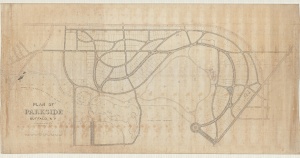
Frederick Law Olmsted's sketch plan of the Parkside neighborhood and Delaware Park, circa 1881.
The PCA continues to address challenges facing older urban neighborhoods. The organization is governed by a volunteer board of directors and relies on neighborhood volunteers who contribute an average of 130 hours per month.
According to the PCA's mission statement, the organization works "to advocate, communicate and act on behalf of the Parkside neighborhood to preserve and enhance the quality of life."
“Thanks to the UB Archives, you can now delve into this microcosm of Buffalo’s history, through ’70s and ’80s urban renewal, ’90s progress and into the historic restoration of the 2000s,” Pritchard said. “We here in Parkside invite you to read about our historic neighborhood and then come see it for yourself.”
The project represents a model for how universities can support their surrounding communities while advancing educational goals.