Stay Informed: Updates, Events and Stories
Living Legacies of Love Canal: How Jordan and Luella Kenny Maintain Cultural Memory with UB Libraries

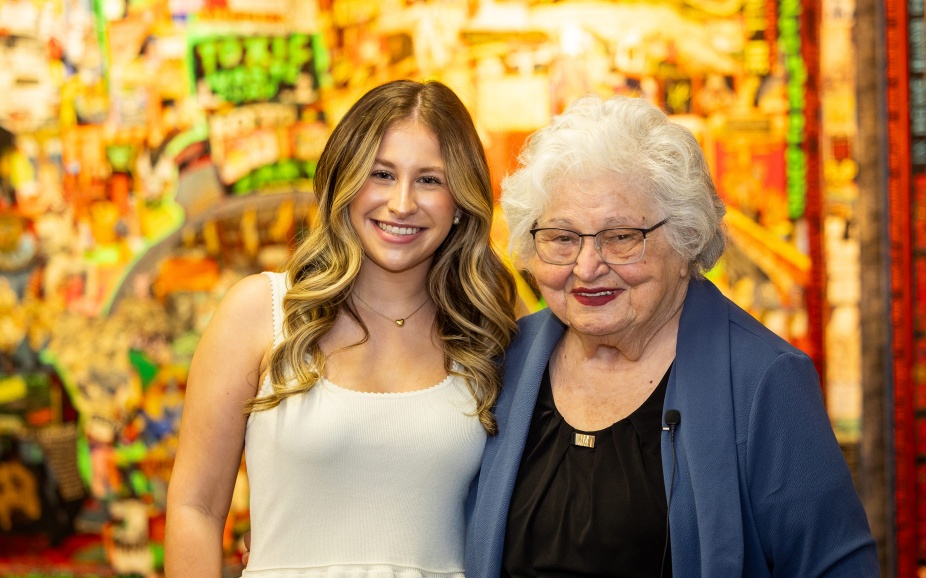
Jordan Kenny (left) pictured with her grandmother, Luella Kenny (right)
by KAITLYN LIU
Published May 12, 2026
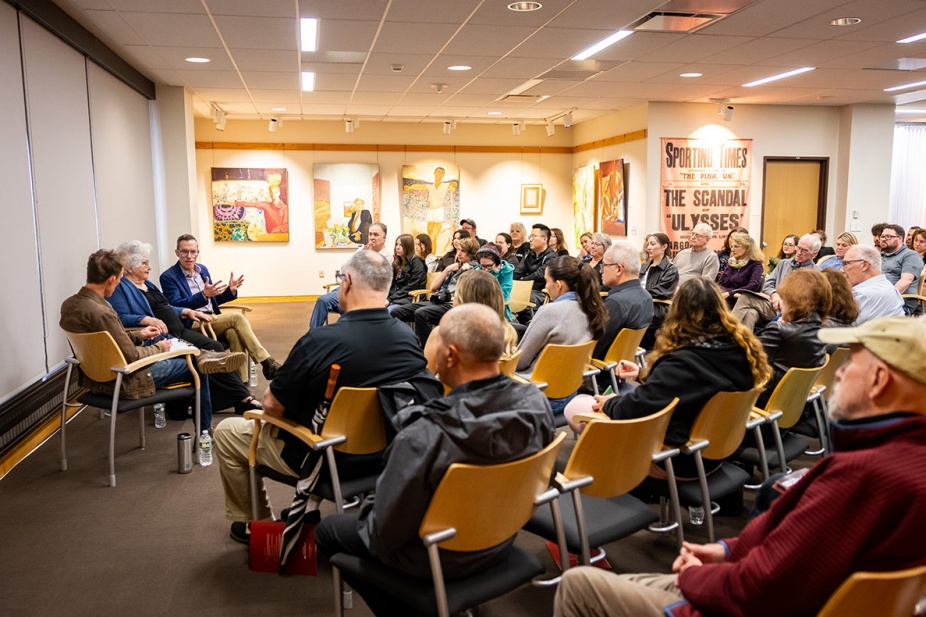
On an April evening in the UB Archives, The New York Times best selling author Keith O'Brien and Luella Kenny stood before an audience together to discuss O'Brien's book, Paradise Falls: The True Story of an Environmental Catastrophe — an extensive account of the Love Canal disaster, the community it devastated, and the residents who fought back. In the book, O’Brien tells the story of Luella Kenny’s experience living amid chemical waste in Love Canal, and the resulting death of her seven-year-old son, Jon Allen. Though she had a personal connection with many audience members that night, there is one person in attendance who warrants particular focus – that being Luella’s granddaughter, Jordan Kenny, a senior at the University at Buffalo (UB).
Following the event, Jordan and Luella sat down to discuss how research, memory and libraries intersect in their shared effort to keep Love Canal's story alive — and what it means to carry that story forward on the 50th anniversary of the disaster.

Luella grew up in what she calls "the era of the library." She took her children regularly, rotating between reading sessions and swimming lessons next door. Today, her granddaughter Jordan steps into a very different kind of library — one with instant digital access to hundreds of databases and the ability to request materials from nearly anywhere in the world. The differences reflect five decades of progress in libraries and academic research, but the consistencies are just as striking.
When Love Canal residents first became aware of toxic seepage from Hooker Chemical dump sites, government and industry officials were slow to respond, forcing residents to turn to community organizing, utilizing citizen science and local knowledge.
Luella, a former cancer research assistant at Roswell Park Cancer Institute, was uniquely equipped to take on this role. After the death of Jon Allen, she began to suspect the toxic waste at Love Canal was to blame, and began cataloging the condition of nearby waterways, analyzing autopsy reports and documenting dying birds in the area. Officials dismissed her findings as the work of "hysterical housewives," insisting no link existed between the dump and any fatalities. Yet it is the erroneous research of various government personnel at Love Canal that makes careful, ethical research a necessary component of education for students like Jordan today.
For both Jordan and Luella, researching Love Canal is personal. When Jordan decided to spend her first semester at UB researching Love Canal for her English 105 course, it was the first time she would encounter academic research that spoke to the stories she heard from her grandmother while growing up. She explained that reading research articles, government statements and scholarship was shocking when “her family lived it,” highlighting the gap between official narratives and her grandmother’s oral histories in a way that was impossible to ignore.
While Luella consulted many libraries over the course of her activist career, research on Love Canal looked very different than it does now. Today, as a UB student, Jordan has instant, digital access to hundreds of databases through UB Libraries’ OneSearch, and the ability to request nearly any article or book across the globe using UB’s Delivery+ system. With Love Canal now considered an iconic story of environmental activism, Jordan was sure to encounter a wealth of resources on the topic.
Jordan explains how Luella’s own research experience makes her more aware of bias in academic research and the need to consult reliable sources. When consulting these sources, Jordan says she is aware that “there are two sides of the story. The government is going to say one thing and then we’re going to say another thing.” She adds, “Luckily, I’m very well educated on this topic, so I can pick through research.”
In an age of disinformation many students have yet to develop this skill, making for a digital environment that, in some ways, reflects Luella’s own history with flawed research industries. For those who may not have this critical literacy, Jordan stresses the need to consult firsthand sources like those offered by her grandmother. In light of this, she chose to interview her grandmother for her final, multimedia project in the course.
Upon being asked what it was like to be interviewed by her granddaughter, Luella jokes that “Luckily, Jordan and I have good rapport.” As an environmental activist, Luella has been interviewed by countless reporters, researchers and writers. Nevertheless, she is most passionate about speaking with students such as Jordan and her classmates at UB. Just in the last few months, Luella has led multiple tours of Love Canal, participated in the UB Humanities Institute’s “These Toxic Times” conference, spoken at book clubs, and held Zoom sessions with university or high school students across the country. Many students who have researched Love Canal and spoken with Luella – including Jordan – have gone on to win awards for doing so. As Luella explained in her keynote at the UB Archives exhibit, what is most important to her is that “no other child dies from corporate irresponsibility.” For that reason, both Luella and Jordan are thankful for UB Libraries’ own commitment to maintaining the memory of Love Canal.
UB Archives recently installed the Toxic Archives: Voices from Love Canal exhibit. The exhibit, located on the third floor of Silverman Library, features a timeline of the disaster, photos of protests and other related ephemera. Given its central location, many UB students pass by the exhibit when they visit the libraries. Jordan mentions the eerie experience of touring the exhibit, saying “I see those kinds of things 100 times and still to this day, I get choked up and can’t even understand or fathom what happened.” On the brighter side, both Jordan and Luella find joy in the exhibition’s streaming of the PBS episode Poisoned Ground: The Tragedy at Love Canal. Luella remarks, “There’s pictures of me half my age and half my size, which is very interesting.” Jordan also describes laughing to herself when she walks to the library only to see her grandma on screen, to which Luella adds, “I’m watching you!”
Beyond the Toxic Archives exhibit, UB Archives also holds extensive Love Canal collections. Jordan browsed the digitized Love Canal Images collection when she returned to researching Love Canal for a public speaking course, relying on the visuals to make an emotional appeal to her classmates. Eventually, Luella plans to donate her own materials to UB Archives. She explains that UB was a natural choice for its already-extensive collection, but she also notes her appreciation for UB’s commitment to sustainability and environmental research. This commitment is perhaps reflected in UB’s recent announcement that they had reached climate neutrality five years ahead of schedule. In this way, Luella situates her own experience at Love Canal research with broader calls for climate action, refuting narratives of simple cleanups or quick solutions.
With materials spanning decades of research at Love Canal and the larger Buffalo region, Luella’s papers will surely make for an illustrious addition to UB Archives’ Love Canal Collection. The research that Luella conducted created a language for discussing Love Canal, offering a foundation for young researchers like Jordan to work from. Though Luella feels she is ready to pass the torch, she admits there is still plenty of work to be done when it comes to fighting corporate irresponsibility and fighting for environmental safety. At this, she points to Jordan, signaling she is the person who can take on this work. Jordan, smiling at her grandmother, says “Yes, on it!”
Though Jordan and Luella are both equally humble about their contributions to Love Canal research and their impact on the larger cultural memory of Love Canal in Buffalo, their impact cannot be overstated. To use O’Brien’s words, not only is Luella a "legend," but these forms of storytelling – Jordan’s research projects, O’Brien’s Paradise Falls, Luella’s public speaking events – would be impossible without the existence of libraries and archives across the nation. As Jordan notes, the UB community is lucky to have so many resources on Love Canal at their fingertips.
That is why, for any research she’s tasked with, Jordan knows “the library is the first place I’ll go.”