Stay Informed: Updates, Events and Stories
The Right People in the Right Building

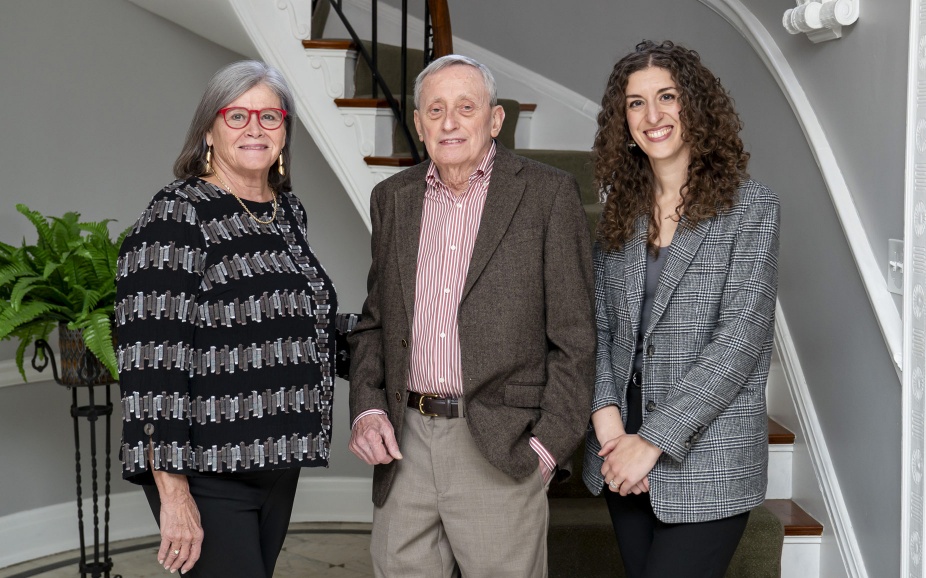
From left, 800 West Ferry Condominium Association President Mary Roberts, former University at Buffalo university archivist John Edens and current University Archivist Hope Dunbar stand inside the historic 800 West Ferry building.
by DENISE WOLFE
Published June 12, 2026
How a remarkable set of 1929 blueprints found a new home


Residents of the 800 West Ferry Condominium Association have long appreciated the beauty and architectural significance of the building they call home. Designed by Duane Lyman, then of Bley and Lyman Architects, as the first luxury high-rise apartment building in Buffalo, the 12-story building is a contributing structure in the Elmwood East Historic District. For decades, the original architectural blueprints and related drawings for the building — 222 items in all — were housed in vintage flat blueprint cases in the building's attic storage area. Residents knew the significance of what was there and sought the best means possible to conserve them.
What happened next is a story about preservation, coincidence, and the remarkable fact that exactly the right people happened to be in exactly the right place.
In 1929, Darwin R. Martin — whose father had commissioned Frank Lloyd Wright to design the celebrated family estate on Jewett Parkway — hired Duane Lyman to build Buffalo's first luxury high-rise apartment building. The result was a 12-story building that architectural historians have described as Art Deco, modern Tudor and neo-Gothic. The Great Depression eventually forced its grand duplex apartments to be subdivided, and by 1980 it had become a condominium association. The blueprints, however, remained.
As part of a broader review of building records in 2025, the condo board, led by President Mary Roberts and the building's Heritage Committee, focused on how best to conserve, categorize and safely house the historic blueprints and architectural drawings. Roberts, who spent years as executive director of the Darwin Martin House, brought both a personal and historical understanding to the effort that few others could have offered.
"Beyond the historical significance of Duane Lyman's architectural legacy, preserving these records was important in order to document and maintain accurate information for infrastructure maintenance and renovations, in keeping with basic preservation standards," Roberts said. "The connection between Frank Lloyd Wright's Martin House and 800 West Ferry is a happy coincidence for me. Having worked for many years at the Martin House, while living in the building commissioned by Martin's son, made the outreach and work with the UB Archives a seamless and fortuitous progression."
The Heritage Committee included John Edens, a former University at Buffalo university archivist who also lives at 800 West Ferry, who helped connect the group with the University Archives. In June 2025, Roberts and Edens contacted Hope Dunbar, the University at Buffalo's university archivist. The University Archives already holds the Frank Lloyd Wright-Darwin D. Martin papers and the broader Martin family collection — correspondence, photographs, diaries and architectural records that trace the family's legacy across generations. The 800 West Ferry blueprints, commissioned by Darwin D. Martin's son, belong to that same story.
"The long history of outstanding stewardship of historical collections, along with the Libraries' preservation expertise in physical conservation and digitization, made UB the appropriate choice," Edens said.
"What made this discovery especially meaningful was how naturally it connected to collections we already steward. Because of the Martin family papers, we're able to place these blueprints within a much larger story about architecture, design and legacy in Buffalo," Dunbar noted.
What followed was a careful, methodical collaboration involving specialists from across the UB Libraries, each bringing the expertise the project required. Ronald Gaczewski, the preservation and access services librarian, took on the task of stabilizing and conserving the documents — carefully housing each of the 222 items in protective Mylar enclosures to protect them from deterioration and prepare them for long-term storage.
"The condition varied, but every blueprint required stabilization. Each one was flattened, tears were repaired and then encapsulated in protective Mylar sleeves. That not only made them safe to handle for scanning but also provided the necessary support for long-term preservation and storage," Gaczewski explained.
Sarah Cogley, digital collections and repositories librarian, and her team then scanned the full collection, while Samuel Kim, the GIS and geospatial librarian, provided storage cases from the map collection that proved a perfect fit for the blueprints in their new home.
"Digitizing these large, fragile blueprints requires careful handling and specialized imaging. Creating high-quality digital surrogates ensures the long-term preservation of the originals by reducing the need for physical handling. Scanned copies will also be provided to the building's facilities staff to support long-term maintenance of this historic building," Cogley said.
"Preservation is often thought of as something quiet or solitary, but in reality, it's deeply collaborative. This project brought together people with very different kinds of expertise, all working toward the same goal of ensuring these materials will be available for future generations," Dunbar added.
In 2029, 800 West Ferry Condominium Association will celebrate the 100th anniversary of the building. The blueprints that helped bring it into being are now part UB Libraries’ permanent collections, accessible to researchers, historians and architects. There is something fitting about how the story unfolded: The right people, it turns out, were already in the right building.