Stay Informed: Updates, Events and Stories
Breaking New Ground: UB Librarians Join College in Prison Program

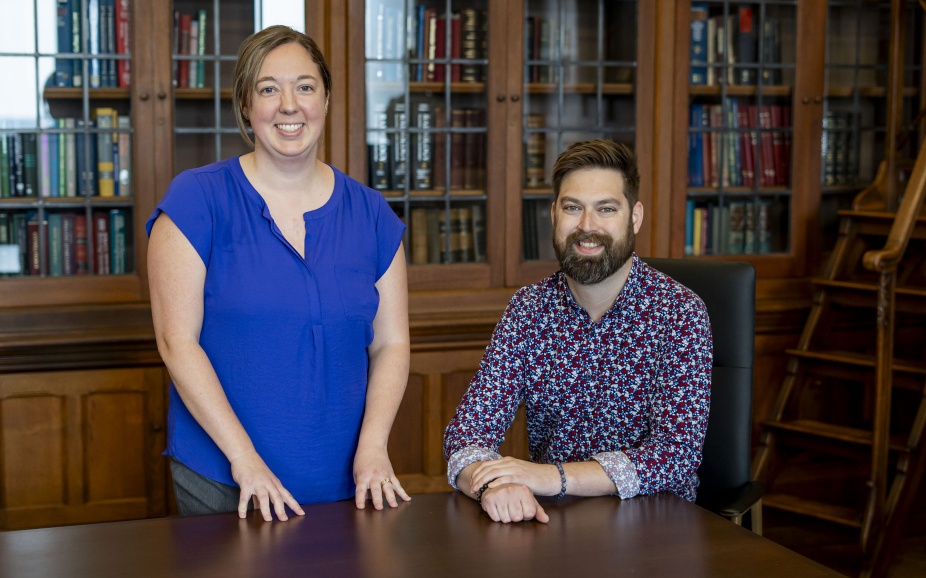
Carolyn Klotzbach-Russell and Bryan Sajecki
by DENISE WOLFE
Published August 11, 2026


Two University at Buffalo librarians are helping incarcerated individuals develop academic research skills as part of UB's College in Prison Program, marking the first time UB Libraries have been involved in the initiative.
While SUNY institutions have participated in higher education in prison programs for some time, the involvement of UB Libraries represents new territory. UB's College in Prison Program offers a BA in Sociology and a Minor in Nonprofit Leadership and is among more than a dozen SUNY campuses offering college degrees in prisons in New York State. The program is offered at Wende Correctional Facility, a maximum-security prison in Erie County, where incarcerated individuals can earn credits toward a UB degree.
Carolyn Klotzbach-Russell, social sciences librarian, and Bryan Sajecki, social sciences, student support and instruction librarian, became involved in the program in 2023 after being approached by Mary Nell Trautner, associate professor of sociology and criminology and director of the program. Recognizing the need for librarians' expertise, Trautner enlisted university colleagues whose work could directly support student success.
"The library's partnership with our program reflects the very best of higher education's public mission," Trautner said. "Carolyn and Bryan have supported incarcerated students directly through research and information literacy instruction, teaching students how to find, evaluate and engage with information critically and ethically. Those skills are especially important in prison education settings, where access to information has historically been restricted and uneven."
Their work is one piece of a larger university-wide commitment, spanning faculty, staff and units across UB. Susan Weeber, clinical assistant professor in the Department of English in the College of Arts and Sciences, structured her ENG 105 course for the program around two research topics, racial segregation in Buffalo and the environmental crisis at Love Canal, both of which offered extensive materials in the University Archives. That was a deliberate choice to help address the research constraints students face, including limited access to full-text articles and no ability to use laptops or access online resources in class.

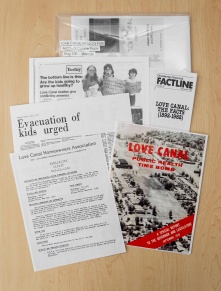
An assortment of facsimile documents and articles from a course pack, provided by the University Archives, documenting the environmental crisis at Love Canal.
UB Archives played a key role as well, developing primary source archival course packs on both topics. After a successful fall 2025 pilot, the partnership expanded in spring, with each student receiving their own folder of printed primary source materials to work with directly.
Before setting foot inside Wende, both librarians completed training specific to working in a correctional facility. The preparation proved essential — teaching research skills without internet or database access required Klotzbach-Russell and Sajecki to fundamentally rethink their approach. All teaching materials had to be reviewed and approved before being brought into the facility.
"We were bridging the gap between conducting academic research and not having access to the resources that usually make that possible," Klotzbach-Russell said.
Though Wende has an on-site library along with a small library in the UB classroom space, it does not carry the breadth of an academic collection. Scheduling conflicts and limited access to dedicated classroom space added another layer of uncertainty, as the facility's educational area was not always available during scheduled sessions and available equipment could change from visit to visit. The librarians responded by always arriving with a backup plan, ready to adapt to whatever the day presented.
"In my initial session in fall 2025, I walked through developing a research question using an example on the chalkboard," Klotzbach-Russell said. "Students then brainstormed topics and submitted them on paper, since electronic options were not available. Bryan and I reviewed the submissions, identified common themes and used them to build a bibliography so students could request relevant materials."
They provided secondary sources on Love Canal and segregation in Buffalo, including academic journal articles, EPA reports and book chapters. When research questions arose that required database access, Klotzbach-Russell and Sajecki brought them back to UB to complete research on the students' behalf.

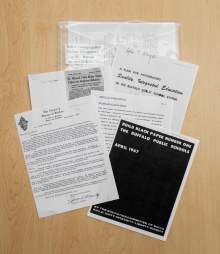
From a course pack provided by the University Archives, facsimile documents and articles documenting racial segregation in Buffalo.
Klotzbach-Russell and Sajecki also created and printed an ENG 105 Library Handbook, designed so students could reference it independently, with or without a librarian present, for use during the course and beyond.
"The handbook really came out of listening to the students," Sajecki said. "Their questions and the challenges they were working through in class shaped what we included. It wasn't something we could have built without that back-and-forth conversation. The students we worked with are among the most interested, the most interesting and the most respectful students I've taught throughout my career."
Klotzbach-Russell and Sajecki plan to continue their involvement in the program, viewing it as a long-term commitment rather than a one-time effort.
Beyond the classroom, they have helped foster broader campus conversations about incarceration, including a book display on books written by incarcerated and formerly incarcerated authors, along with a discussion panel, extending the program's reach beyond Wende and into the wider UB community.
"This is an underrepresented and underfunded part of the community," Klotzbach-Russell said. "And we want to keep showing up for them."